28 Jul 2026
A three legged stool, and why three legs never rock
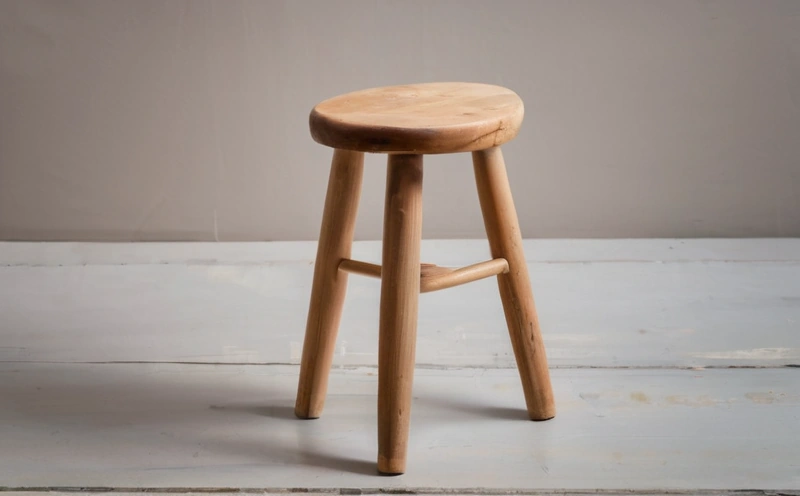
A three legged stool is the smallest piece of furniture worth taking seriously. One stool takes a weekend, uses about a metre of 40mm ash, and teaches angles, tenons and wedges in a single project. Eleven of these stools have left this workshop, mostly as gifts, and the eleventh was noticeably better than the first.
Why does a three legged stool never rock?
Three points define a plane, so the three feet of a three legged stool all meet the floor at once whatever the floor is doing. A four legged stool needs four feet in one plane, and a floor tile out by 1mm breaks that condition, which is why café tables collect folded beer mats and milking stools do not.
Three legs pay for that steadiness with a smaller safe zone. Tipping a three legged stool means crossing one of three edges rather than one of four, so the base of support is a triangle rather than a square. Splay angle is the number that buys the lost area back.
How thick should a stool seat be for wedged through tenons?
An ash stool seat 38mm thick and 300mm across gives a 25mm through tenon about 2,980 square millimetres of glue surface inside the hole. A 25mm thick seat gives 1,960 square millimetres, and both back legs on stool number three worked loose inside a year at that thickness.
| Seat thickness | Glue surface for a 25mm round tenon | Deepest comfortable dish | Condition after one year of use |
|---|---|---|---|
| 25mm | 1,960 mm2 | 5mm | Two legs loose on stool number three |
| 32mm | 2,510 mm2 | 6mm | Sound, tenons still tight |
| 38mm | 2,980 mm2 | 8mm | Sound on the eight stools built since |
Each seat is cut round on a 300mm bandsaw and cleaned up with a spokeshave, then hollowed about 8mm deep in the middle with a scorp and a travisher. Eight millimetres of dish makes an hour of sitting far more comfortable, and the dish decides whether a stool gets used or gets moved out of the way.
What leg splay angle keeps a three legged stool stable?
Legs splayed 12 degrees from vertical, set 120 degrees apart on a 180mm pitch circle, put the feet of a 450mm high stool on a circle about 355mm across. The 355mm circle is wide enough to lean on and narrow enough to push under a bench, and 12 degrees is the angle used on every stool since number four.
| Splay from vertical | Foot circle on a 450mm stool with a 180mm pitch circle | Behaviour in use |
|---|---|---|
| 6 degrees | 267mm | Tips when a sitter leans back over one edge |
| 12 degrees | 355mm | Steady under a leaning sitter, tucks under a 700mm bench |
| 18 degrees | 448mm | Steady, but the feet catch ankles and will not tuck away |
Drilling the seat at a consistent 12 degrees is the fiddly part. A sliding bevel set to 12 degrees stands on the seat beside the drill point, lined up with a pencil line running to the centre of the seat, and a helper watching from 90 degrees away catches the sideways error the driller cannot see. A 25mm auger bit enters from the top face, stops when the lead screw breaks the underside, then finishes from below to avoid a blown out exit.
A one degree error in the drilled angle moves the foot about 7mm on a leg that hangs 412mm below the seat. Three legs each wrong by a degree in different directions give a stool that stands perfectly well and looks drunk from across the room.
How are wedged through tenons cut and oriented in an ash stool seat?
Each ash leg carries a 25mm round tenon 40mm long, standing 2mm proud of a 38mm seat. A dovetail saw cuts a kerf 30mm down the centre of each tenon, and the kerf runs across the grain of the seat so that a dry oak wedge, ground to 4 degrees included, spreads the tenon where the seat can resist.
Wedge orientation is the detail most people get wrong, and the detail I got wrong on stool number two. A kerf aligned with the seat grain drives a split straight along the seat, and that split usually appears a day later with a sound like a knuckle cracking.
Moisture content in the leg against moisture content in the seat decides whether the joint tightens or loosens over its first summer. A leg tenon at 6 percent going into a seat at 9 percent gains moisture and swells while the seat dries and shrinks onto the tenon.
| Leg tenon moisture | Seat moisture | What the joint does over twelve months |
|---|---|---|
| 6 percent | 9 percent | Tenon swells, seat shrinks onto the tenon, joint tightens |
| 9 percent | 9 percent | Both parts move together, joint holds |
| 12 percent | 8 percent | Tenon shrinks inside a stable hole, joint loosens every summer |
Glue goes into the hole and onto the tenon, the leg goes home with three mallet blows, then the wedge takes lighter taps until the sound changes from a knock to a solid thud. The change from knock to thud is the signal to stop the mallet. Two more blows after the thud is how an ash seat gets split.
How are the three feet levelled after glue up?
Twelve hours after glue up the tenons saw flush with the ash seat, and levelling comes last. The stool stands on the flattest surface in the workshop, a cast iron tablesaw table, and a pencil resting on a block scribes one line around all three legs. Sawing to that line puts three feet in one plane.
A 5mm chamfer filed around each foot keeps the end grain from splintering when the stool is dragged across a stone floor. Total build time is about nine hours across two days, plus finishing, and ash takes oil well enough to reach a warm straw colour after three coats.